Many important towns and cities are located on the coast , like capital city Rabat or famous Casablanca .

From Marrakech I got to Agadir on the bus , there is a new highway linking these cities , however I was hoping the bus would ride the old road , crossing Atlas and through Taroudannt . Much more spectacular route . But it didn't - I arrived in Agadir before midday . When I got out the bus and had a look around , I wasn't sure if wanted to stay there . According to my guide book , this city was a cheap package-tourism resort . After a short walk to cash point nearby , I decided to go to Essaouira . A taxi driver ( who was urgently waiting for my decision ) offered me to take me to this town . I refused , travelling by the taxi a distance of 170 km is too expensive . Instead , I took a bus , soon leaving to Essaouira .
On the bus I sat at the last row , as the bus was nearly full . My neighbour , a guy in his twenties speaking smooth english , explained me that on that bus nobody sat according to numbers on tickets . This was a minor bus company , so standards were lower. Anyway , we didn't have to wait long , that was an advantage . A bit further on , he warned me that soon the road would be uneven - making passengers sick . And the driver's assistant started giving out plastic bags - just in case . I didn't have to use it - I never got the locomotion sickness , and the road wasn't so bad actually . Well , the bus company was focused on customers' comfort . My travel companion was on holidays , travelling like me around the country . He spent two or three days in Agadir , relaxing on the beach , now moving to Essaouira where his relatives lived . However , he wasn't intending to stay at their place - to feel free and comfortable had booked a hotel earlier . He was kind to explained me some things about Morroco . For instance , told me about Phosphate's mining- quite rare mineral , mined for use in agriculture and industry .Morocco has an important position as exporter of that raw material . Especially Japanese buy Morrocan Phosphate, to extract from it Uranium

Arid scenery somewhere near Agadir
 In Essaouira again I had to find at first a hotel , what I did with a help of a local man , in medina . I installed in a nice riad and went to see around . The souks on the narrow streets were busy , but the town seemed to be sleepy . Not too many tourists . No wonder that everybody stops there for short time - the wind is unbearable . And terribly cold , then in april . At more open space the wind flings grains of sand into your eyes . I stopped for a mint tea in a bar , on the edge of empty square . The bar was empty too - I could see a waiter spraying water outside , on the ground . I thought that probably he did that to prevent dust , coming with gusts of wind . I moved back to medina to find entry to the fortress . Walked along the main aisle in old town and got to the gate on the other side of town's walls . More interesting area with fine buidings and big square . In the narrow street by the gate I found a large store , with local crafts. Beautiful and cute items made of wood mainly , stone and metal either. A bit like an exhibition , but you can buy all items , of course . On the square off the medina's walls, I met a guy who was selling sweet cokies . He was strolling in the area , carring them on the tray . I chatted with him for longer moment , as he wasn't hassling one . Finally he proposed me to buy a piece of hashish , he even wanted me to go test the quality on the side . But I refused , maybe tomorrow , I said . I tried yet to get to ramparts of the old fortress , but seemed to have been closed at that time of day . So I had a look at a fishing harbour nearby , took some pictures of the sunset over the ocean and move back to have a rest in my hotel . I was frozen . The wind battering the waterfront was getting colder
 The Bastions in Essaouira was built in the 18 th century by Frenchmen , to decision of Sultan Sidi Mohammed , to protect trans-saharan trade . At that time Essaouira became one of the most important ports of Morocco . Now this is only a sleepy coastal town , with fishing port and traces of the past glory .
Next morning I was leaving Essaouira . Too windy and I was curious of next places , ahead in north . Before I took a bus , I bought a wooden mask , used by Black Africans for ceremonies . Nice to see it now , hanging on the wall . Anyway , I got to El Jadida , my next stop , in the afternoon . And I was surprised - it was kind different town then any other I had seen in Morocco by then . Because of really very few tourist , so nobody was proposing me to find me a hotel or anything else . So there was hard to find somebody speaking English , too . Mostly French , of course , and Spanish . I went down to boulevard , stretching along the shore from the center to the harbour and the Old Town . This costal area looked very exlusive , with residential buildings , offices or banks . I walked a mile along a palm avenue and close to the harbour scenery changed . More in colonial style , I would say . I passed a huge white building , the sign read " Hotel Maghreb " . Possibly former french colonial hotel or official building . After a moment of hesitation , I moved ahead , hoping to find an accomodation in the Old Town .

 Night panorama of El Jadida from the roof of my hostel
  Next morning I decided to stay another day in El Jadida , but my plan was to move out and check in to cheaper hotel . Before I left Portuguese City , I went to see Old Cisterns , built by the Portuguese in 1514 . It was a source of fresh water , cought after rain . Now the place is famous for the reflections of the ceiling in the water . The cisterns is a popular scenery for filmmakers too . Most famous was Orson Welles , who shot there the scenes for the adaptation of "Otello" . The cisterns are declared as World Heritage site by UNESCO .Worth going to take some pictures , walking is limited by pools of water .
For the next night in El Jadida I stayed in " Hotel Maghreb " , I was curious of that old building . Located in the centre and by the sea , so I came there quickly . The front wall over the hotel entry was being repainted at the moment . But when I went into the building , I could see that whole interior needed a very complex restoration . That would require a lot of money . But I couldn't imagine however , that these very few budget guest I saw , could bring enough incom to carry out such renovation . Anyway , there were spacious halls , huge staircase and wooden window covers . Nothing had changed probably over the time , I thought . The toilets were crumbling down , filthy and in complet mess . The smelly room I got had big wooden bed , but bedding wasn't fresh . Well , good accomodation when you only need to stay one night and go away early morning . So after a stroll across a town and having had a look at souk late evening , my stay in that pleasant coast town was over . Next morning I took a taxi to a train station , which is located on the very edge of the town , among the fields . And the first time during my stay in Morocco , the taxi driver used a taxometer .

Hotel Maghreb France in El Jadida
I got to Casablanca quickly . That's only 100 km distance from El Jadida , so train journey lasts no more than an hour . Getting out of the train station the first thing to notice are tower buildings , in Casablanca's City . The largest city in Morocco is a financial and industrial capital . With a very important see port . After strolling in the
central areas I took a taxi to the Grand Mosque , near the harbour . The most grandiose mosque in
Morocco was built in 1993 and partly built on the ground reclaimed from the Atlantic Ocean . It claims to
have capacity of 25 000 worshippers inside and has the tallest minaret tower in the world ,over 200 m etres. I was really impressed , especially at twilight when the mosque is artificially lightened up with . I didn't go inside
as I hadn't booked a ticket for a guided tour .
 The Hassan II Mosque looks fabulous after sunset
  I was picked up by the Mosque by Younes , who hosted me two nights over my stay in Casablanka . He just finished his work and got there late afternoon , by the chance he went inside the temple for short prayer . I couldn't go there , for obvious reason . However , Younes told me that sometimes he used to see non - muslims inside , who had to be somehow accepted by an imam .
Younes worked for an international softwear company , which had outside Casablanca it's logistic base and call centre , for quite a large part of the world , including Europe . That location surely because of lower costs in Morocco . My host took me on his car to show me a " Casanegra " - that's how the people call their city during the night hours ( Casa Blanca means "white house" in Spanish ). And Younes soon showed me some examples ; two taxi drivers stopped cars and started arguing fiercely , nearly fighting . A couple of streets further next to an exlusive hotel the police were taking a prostitute ( this is of course illegal occupation in Morocco ) , pushing her to a police car . Well , this is the night life of a big metrpolis . When we were passing a small mosque , one lane of the road was closed , so we had two slow down in order to get through . What happens ? " Och , I know , the king is coming tomorrow for the friday pray , it's his favourit place "
The road and surrounds were being cleared out by workers , new flowers planted to make the place look " nice and tidy " . According to Younes , that had been always like that , to show the king Mohammed VI the country flourishes . And it is bad , as the king could have a false picture of the country . The 46 years old king is known as a reformator , and has been trying to eradicate the poverty . So , Younes was contuining , the worst thing was that the king had been surrounded by people who didn't care to change the country at all .


Roman Catholic Cathedral in Casablanca
Casablanca is nowadays a huge city , with population of 3 000 000 people and I was often lost in the city . And not much to see except for city center , whith some buildings from colonial time . The medina is not impressive . I liked the most the area of the Grand Mosque . Two days for Casablanca was enough - I left to Rabat on the train .
Viev across a river toward Sale , the town on the other side of the estuary
 The centre of Rabat looked very different than other cities - many representative buildings and avenues. And cleaner and quieter . It is a political and administrative centre of Morocco . A tramline was running from the train station , so I followed the line to the Hassan Tower , the old unfinished mosque tower . Next to the tower I found the Mausoleum of the first king of independent Morocco , Mohammed V . Many Moroccans were visiting the place .
  The 45 m- high minaret ( Hassan Tower ) was build in the end of XII century , when the construction of the mosque was abandoned in 1199 . Originally the Tower would have been 60 m high .
In Rabat I felt as a reborn - the air was fresh after the rain and a slight breeze from the Ocean was really refreshing . But soon the weather changed again - the clouds were back and it started to rain . So I took my time sipping a mint tea in the restaurant next to the river . Fortunatelly , the sky cleared out in no more than an hour and I could go to the Rabat's Medina .

The view of Kasbah des Oudaias
 The garden inside the kasbah
I walked to fortified part of Medina , kasbah Oudaias , at the mouth of the river . There is a great viewpoint at far corner of the kasbah , overlooking the estuary , the city and the Ocean . I had read earlier in my pocket guidebook that by the kasbah gate I would meet unofficial guides , trying to tell that the kasbah is closed for prayer . And indeed , two men hanging out by the entry told me that . Of course it wasn't closed . Inside , by the Museum of Moroccan Arts I found a beautiful Andalucian garden . Later on , after contemplating the citie's panorama from the view's terrace , I went down , to the Medina . Rabat's medina is easy to walk , clean and not so crowded like others medinas in largest towns . Having had just a litlle time before leaving Morocco , I took a taxi outside medina and rushed to a bus station . I wanted to get to Larache the same day .

Moroccan capital seen from the kasbah across the estuary
I arrive in Larache after 2,5 hrs journey , late afternoon . It was raining and cold . When I was getting out the bus , a small crowd of people run up , wanting to get on . First - come first - served . A moment later another bus came and waiting people were chasing the slowly rolling vehicle . Having seen these scenes , I decided immediately to buy a ticket for the next day in advance . The CTM's ticket office was still opened - so I bought the ticket to Tangier . There was a Spanish girl inside the office . She was waiting for her bus to Rabat - outside it was still rainy . She was spending a couple of days in Morocco , travelling like me , but she had visited this country before . She explained me how to find an accomodation ( I went to really cheap pensionat Almala nearby ) . By the way , she told me that on the first of May would be the change of the time . I was surprised ; but she continued that that change was due to time of Ramadan , a month of the fast . Ok , I thought , that day I would have been on the way to Gibraltar , from spanish Ceuta . But as the future will show , I would be surprised again .

Shortly after checking in at the pensionat , the down pour was finished and the sky cleared out . So I rushed for a walk around the town . This town looked the most interesting of all costal towns I had visited before . Very well looking town centre and amazing views over the bay , medina and a wide estuary . a long bridge led to the other side , across the river . I could see nice beaches behind estuary , but the weather wasn't welcoming , as for
staying on the beach .
Fountains in the central plaza of Larache

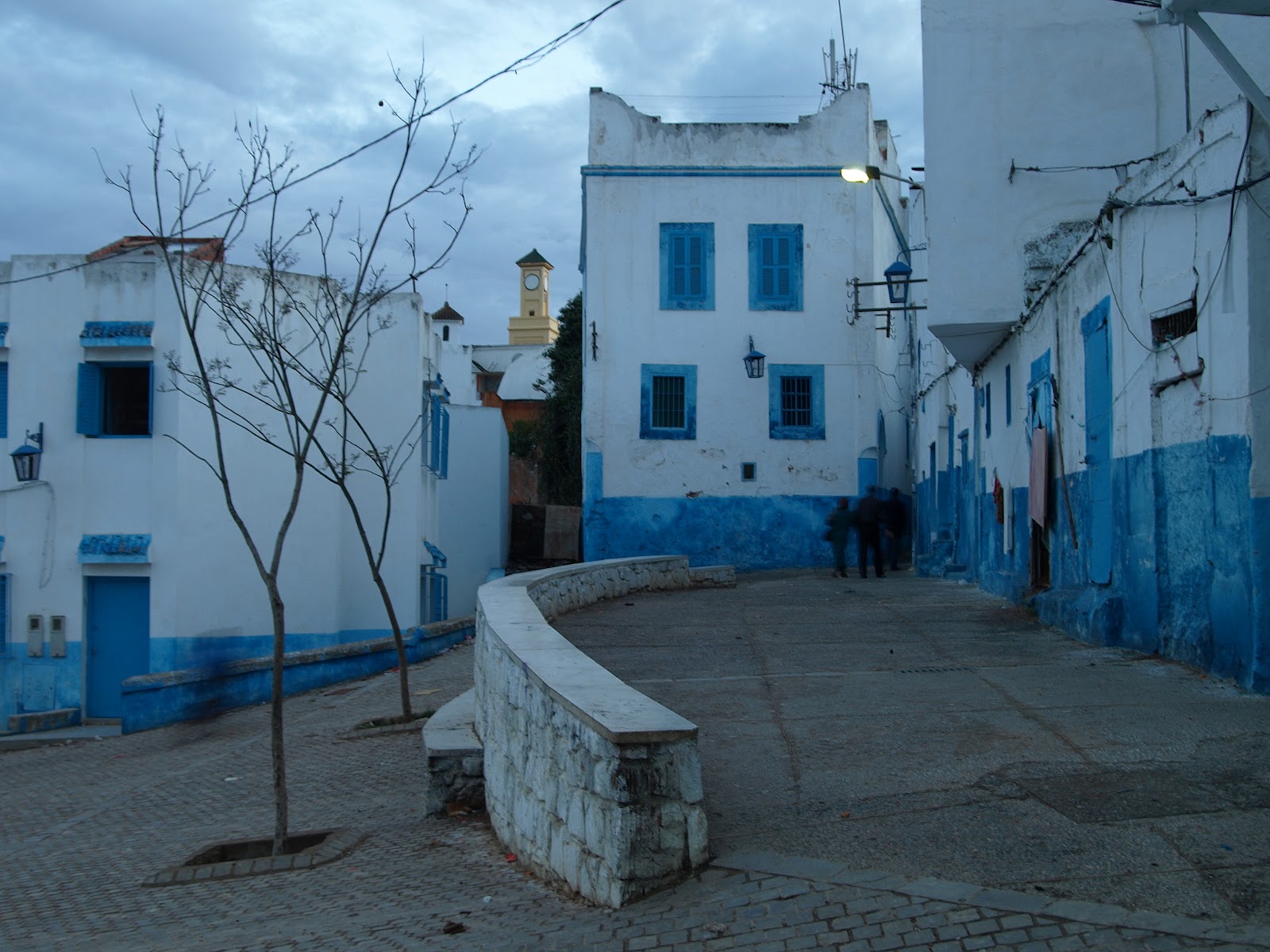
The striking thing in Larache were colours , especially of blue buildings of Medina , slopping down toward estuary and the Ocean . I took some time before the sunset , wandering in Kasbah with steep , narrow litlle streets and blue painted walls . The most beautiful medina I have seen in Morocco . The perfect place if one wants to take colourful pictures .
These litlle guys started posing , when I was passing with camera and had a fun , having seen the effect on the display screen 
 . Kids are never shy of camera and often willingly approach the camera .

 . Kids are never shy of camera and often willingly approach the camera .
Outside the medina I passed a white , Spanish church , so I stopped to take a picture of it . But a man who had just parked his car next to me , started talking to me about taking pictures . He sais I would need an authorization of the police . He spoke French but I could make out what he was talking about . I showed him that's only building , not people . He went away , still talking about the authorization . I didn't think I would have to have permission , just to take pictures of public objects . But anyway , I decided to be more cautious when using my camera .

 Kebibab Fortress at the mouth of Loukkos River was build in
15th cenrury and in 17 th century was used by the Spanish
as a hospital . Now the ruin , in the state of total decline .


15th cenrury and in 17 th century was used by the Spanish
as a hospital . Now the ruin , in the state of total decline .
 Street stalls in medina , as everywhere in Morocco , are busy when darkness falls
The next morning I was planning to see the ruins of antic city Lixus , across estuary . But the rain made me to change the plan . Beside , I found out it's difficult to get back to the town , as buses were not often going there and no chance to pick up a taxi at the ruins . Instead I went along the shore toward lighthouse . I found over there cliffs and the old christian cemetery , with a chapel . Quite an extraordinary place , just above the ocean , overlooking the medina .

Christian graveyard

I couldn't guess the function of this building , but the name " Matadero " sugests the Spanish built it

At 11 am I left Larache , on the bus to Tangier . I didn't have much time to stay in that town , but surely it has specific charm and no rush can be found in there . Just the place where one can spent the time , discovering many secret places . On the other side of the estuary I saw nice beaches , so that would be nice get there when the summer is in full . At the time ( april ) the weather condition were poor as for sunbathing .
Maybe one day I will visit Larache one more time .
And again , on my arrival in Tangier , my last stop on the Atlantic coast , I got into rain , at the moment even very heavy . Fortunatelly , it stopped after a half an hour and I could enjoy the beauty of this city .

More photos from Morocco just in this link


